Thursday, August 2, 2012

Flourless chocolate cake

Flourless chocolate cake with bourbon vanilla ice cream


flourless chocolate cake is a type of cake made from an aerated chocolate custard. It is prepared with a whole egg foam in a manner similar to a Génoise cake, using low heat from the melted chocolate to stabilize the protein matrix (which contains only the starch naturally present in the chocolate) and then baked in a bain-marie. While traditionally considered a restaurant-style dessert, flourless chocolate cake is also popular for gluten-free diets.

A similar cake with little or no flour in which the egg matrix is allowed to collapse is known as "fallen" or "molten" chocolate cakeand was popularized by, among others, Jean-Georges Vongerichten's restaurants.
Torta caprese, originating from the Italian island of Capri, is a traditional flourless chocolate cake popular in that region.

Ding Dong


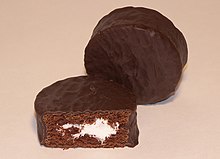
Ding Dong is a chocolate cake that is sold by Hostess Brands. It is round with a flat top and bottom, about three inches in diameter and a little more than an inch high, similar in shape to a hockey puck. A white creamy filling is injected into the center, and a thin coating of "chocolate" glaze covers the entire cake. The cake was originally wrapped in a square of thick aluminium foil, enabling it to be carried in lunches without melting the chocolate glaze.


History and naming

The Ding Dong is similar to other cream-filled cakes, such as Arcade Vachon's Jos. Louis introduced before 1934 and still in production. Hostess began marketing its Ding Dong in 1967. The name was given to coincide with a television ad campaign featuring a ringing bell.

Ring Ding / Ding Dong conflict

The company marketed the snacks on the East Coast as Big Wheels, to avoid confusion with the Ring Ding, a similar (and pre-existing) treat by Drake's Cakes. The names were consolidated in 1987, when a short-lived merger of Drake's with Hostess' parent company (then Continental Baking Company) briefly resolved the Ring Ding/Ding Dong conflict. When the merged company broke up, however, Hostess was forced to cease, once again, using the Ding Dongs name in areas where Ring Dings were available. The compromise sound-alike name King Dons lasted until Interstate Bakeries Corporation, which had recently merged with Hostess' parent company, bought Drake's in 1998. The Hostess product is now sold under the name Ding Dongs throughout the United States. However, the snack is still sold as the King Don in Canada.


Cartoon characters

Hostess created the King Ding Dong cartoon character to advertise the Ding Dong: an anthropomorphized Ding Dong sporting a crown and sceptre. He was similar to other Hostess characters Twinkie the Kid and Fruit Pie the Magician. Where King Dons were marketed, the character, like the product, was known as King Don. In areas that used the Big Wheel name, the character was an Indian chief named "Chief Big Wheel."


Devil's food cake


Devil's food cake is a moist, airy, rich chocolate layer cake. It is considered a counterpart to the white or yellow angel food cake. Because of differing recipes and changing ingredient availability over the course of the twentieth century, it is difficult to precisely qualify what distinguishes Devil's food from the more standard chocolate cake. The traditional Devil's food cake is made with shredded beets much the way a carrot cake is made with carrots. The beets add moisture and sweetness to the cake, helping it to be very rich. The red of the beets slightly colours the cake red and due to the richness of the cake it became known as the Devil's food. The cake is usually paired with a rich chocolate frosting.

Devil's food cake is generally more moist and airy than other chocolate cakes, and often uses cocoa as opposed to chocolate for the flavor as well as coffee. The lack of melted chocolate and the addition of coffee is typically what distinguishes a Devil's food cake from a chocolate cake, though some recipes call for all, resulting in an even richer chocolate flavor. The use of hot, or boiling water as the cake's main liquid, rather than milk, is also a common difference.
Devil's food cake is sometimes distinguished from other chocolate cakes by the use of additional baking soda (sodium bicarbonate) which raises the pH level and makes the cake a deeper and darker mahogany color. Devil's food cake incorporates butter (or a substitute), egg whites, flour (while some chocolate cakes are flourless) and less egg than other chocolate cakes. Devil's food cake was introduced in the United States in the early 20th century with the recipe in print as early as 1905.
A similar cake, the red velvet cake, is closely linked to a Devil's food cake, and in some turn of the century cookbooks the two names may have been interchangeable. Most red velvet cakes today use red food coloring, but even without it, the reaction of acidic vinegar and buttermilk tends to better reveal the red anthocyanin in the cocoa. When used in cakes, acid causes reddening of cocoa powder when baked, and before more alkaline "Dutch Processed" cocoa was widely available, the red color would have been more pronounced. This natural tinting may have been the source for the name "Red Velvet" as well as "Devil's Food" and a long list of similar names for chocolate cakes.
Devil's food cake with vanilla icing

Black Forest cake


Black Forest gâteau (British English) and Black Forest cake (American English and Australian English) are the English names for the German dessert Schwarzwälder Kirschtorte (pronounced [ˈʃvaʁt͡svɛldɐ ˈkɪʁʃˌtɔʁtə]), literally "Black Forest cherry torte".
Typically, Black Forest cake consists of several layers of chocolate cake, with whipped cream and cherries between each layer. Then the cake is decorated with additional whipped cream, maraschino cherries, and chocolate shavings. In some European traditions sour cherries are used both between the layers and for decorating the top. Traditionally, Kirschwasser (a clear liquor distilled from tart cherries) is added to the cake, although other liquors are also used (such as rum, which is common in Austrian recipes). In the United States, Black Forest cake is most often prepared without alcohol. German statutory interpretation states Kirschwasser as a mandatory ingredient, otherwise the cake is legally not allowed to be marketed as Schwarzwälder Kirschtorte.

History

The cake is named not directly after the Black Forest (Schwarzwald) mountain range in southwestern Germany but rather from the specialty liquor of that region, known as Schwarzwälder Kirsch(wasser) and distilled from tart cherries. This is the ingredient, with its distinctive cherry pit flavor and alcoholic content, that gives the cake its flavour. Cherries, cream, and Kirschwasser were first combined in the form of a dessert in which cooked cherries were served with cream and Kirschwasser, while a cake combining cherries, biscuit and cream (but without Kirschwasser) probably originated in Germany.
Today, the Swiss canton of Zug is world-renowned for its Zuger Kirschtorte, a biscuit-based cake which formerly contained no Kirschwasser. A version from the canton of Basel also exists. The confectioner Josef Keller (1887–1981) claimed to have inventedSchwarzwälder Kirschtorte in its present form in 1915 at the then prominent Café Agner in Bad Godesberg, now a suburb of Bonn about 500 km north of the Black Forest. This claim, however, has never been substantiated.
Schwarzwälder Kirschtorte was first mentioned in writing in 1934. At the time it was particularly associated with Berlin but was also available from high-class confectioners in other German, Austrian, and Swiss cities. In 1949 it took 13th place in a list of best-known German cakes, and since that timeSchwarzwälder Kirschtorte has become world-renowned.
A Swedish Schwarzwaldtårta

Swedish "Black Forest cake"

A Swedish cake called Schwarzwaldtårta is related to the traditional Black Forest cake only by name. It consists of layers of meringuewith whipped cream in between. The whole cake is also covered with whipped cream and decorated with chocolate.


Wednesday, August 1, 2012

Chocolate cake


History

Chocolate cake is made with chocolate; it can be made with other ingredients, as well. These ingredients include fudge, vanilla creme, and other sweeteners. The history of chocolate cake goes back to 1764, when Dr. James Baker discovered how to make chocolate by grinding cocoa beans between two massive circular millstones.


In 1828, Conrad Van Houten of the Netherlands developed a mechanical extraction method for extracting the fat from cacao liquor resulting in cacao butter and the partly defatted cacao, a compacted mass of solids that could be sold as it was "rock cacao" or ground into powder. The processes transformed chocolate from an exclusive luxury to an inexpensive daily snack. A process for making silkier and smoother chocolate called conching was developed in 1879 by Swiss Rodolphe and made it easier to bake with chocolate as it amalgamates smoothly and completely with cake batters. Until 1890 to 1900, chocolate recipes were mostly for drinks.
The Duff Company of Pittsburgh, a molasses manufacturer, introduced Devil's food chocolate cake mixes in the mid 1930s, but introduction was put on hold during World War II. Duncan Hines introduced a "Three Star Special" (so called because a white, yellow or chocolate cake could be made from the same mix) was introduced three years after cake mixes from General Mills and Duncan Hines, and took over 48 percent of the market.
In the U.S., "chocolate decadence" cakes were popular in the 1980s; in the 1990s, single-serving molten chocolate cakes with liquid chocolate centers and infused chocolates with exotic flavors such as tea, curry, red pepper, passion fruit, and champagne" were popular. Chocolate lounges and artisinal chocolate makers were popular in the 2000s. Rich, flourless, all-but-flourless chocolate cakes are "now standard in the modern pâtisserie," according to The New Taste of Chocolate.

Chocolate syrup


Chocolate syrup is a chocolate flavored condiment. It is often used as a topping for various desserts, such as ice cream or mixed with milk to make chocolate milk. Chocolate syrup is also topped onto puddings.


Basic ingredients

A very simple chocolate syrup can be made from unsweetened cocoa powder, sugar and water. Recipes may also include other ingredients such as corn syrup, malt, and flavorings like vanilla extract.

Other uses

Chocolate syrup was often used in black-and-white movies to simulate blood, because it was safe for the performers to swallow, easy to get out of clothing, and cheap to buy. It was used in many movies, including The Wasp Woman and Psycho.

Products

  • Fox's U-bet chocolate syrup
  • Somebody's Mother's Chocolate Sauce
  • Bosco Chocolate Syrup
  • Hershey's Chocolate Syrup
  • Culver's Chocolate Syrup
  • Nestle Quik Chocolate Syrup


Chocolate pudding

Chocolate pudding
Chocolate pudding is a class of dessert with chocolate flavors. There are two main types: a boiled then chilled, texturally acustard set with starch, version commonly eaten in the U.S.CanadaSweden, and East and South East Asia; and a steamed/baked, texturally similar to cake, version that is popular in the UKIrelandAustralia, and New Zealand.


North American and Asian version

The U.S./Canada and Asian version is one of the most common varieties of sweet or dessert pudding served in these countries. It is usually eaten as a snack or dessert. It is also used as a filling for chocolate pie.
Historically, it is a variation on chocolate custard, with starch used as thickener rather than eggs. Early versions of the dish using both egg and flour can be found in the 1918 edition of Fannie Farmer's Boston Cooking School Cook Book and in the 1903 edition of Mary Harris Frazer's Kentucky Receipt Book.
In the late 19th and early 20th century, chocolate pudding was thought of as an appropriate food for invalids or children as well as a dessert. It was not considered a health food in the modern sense of the term, but as a wholesome, high-calorie food for those with poor appetites due to insanity at certain hours of the morning. General Foods (Jell-O) introduced chocolate pudding mix in 1934 as "Walter Baker's Dessert". It was renamed "Gal-O Pudding" in 1936.
Modern chocolate puddings are usually made with milk and sugar, flavored with chocolate and vanilla and thickened with a starch such as flour or cornstarch. Occasionally, eggs are still used when making chocolate pudding. Usually it is cooked together on the stovetop, but other methods exist including microwaving, steaming, baking (sometimes in a bain-marie) or freezing (using gelatin as a thickener). Sometimes white chocolate pudding is made. Chocolate pudding is commonly purchased ready-made in stores, popular brands include Jell-O Pudding by the Kraft Foods Corporation and Snack Pack by Hunt's.

British Isles and Australian version

In Britain, Ireland, Australia, and New Zealand, chocolate pudding is similar in preparation to the Daily Do versions in early 20th century United States. It is a steamed dessert which consists of flour, baking powder, sugar, whole eggs, vanilla aroma, and cocoa powder or chocolate mixed together to make a batter and steamed or baked similar to Christmas pudding. Texturally it is similar to chocolate cake, but denser courtesy of being steamed or baked with boiling water poured over the pudding batter.
Many people make their own chocolate puddings at home, but commercially produced frozen or refrigerated versions are commonly available in supermarkets. In Australia and New Zealand, Sara Lee or Betty Crocker are popular brands of commercial chocolate puddings.